
Violence and Faculty Roles

There was a lot of talk about this stuff last year after the horrible events at Virginia Tech, and in some venues, these things are still being discussed, I imagine, But where I teach, we seem to still be in reactionary mode – responding to individual incidents without a protocol in place. I find this very frustrating.

Just this past week, two young women got into a fight outside my classroom door. I stepped out, called security, and the security officer sent them their separate ways. I went back into the classroom, taught for an hour, and then heard screaming – real screaming – in the hallway. Without really thinking, I told my students to stay in the room, and then I stepped out into the hallway again. This time, the women were physically fighting, one bending over the other who lay on the ground. Another professor ran over and pulled the girls apart. Again, I tried to call security – no one answered the switchboard – so another English professor went running for help. In that moment, before anyone else arrived, one of my students – the sister of one of the girls involved – charged down the hallway to go after the girl who was hitting her sister. I had to physically restrain her.

The aftermath of this incident took the rest of my day and resulting in me having to dismiss my morning class and cancel my afternoon class. I typed up a statement, but never was “debriefed” formally on the incident. And although this event took place last Thursday – four days ago – no one has told me what the follow-up is.

Now I imagine I was not informed of things or really talked to about the incident because I am supposed to be “incidental” to this situation. But because of my school’s lack of protocol and adequate security, I – and one of my colleagues who ended up sequestering one of the girls and her sister in our writing lab – ended up being two of the crucial lynchpins in the quelling of this fight. (Did I mention these girls were on an athletic team that had apparently taken clear sides on this disagreement?)

I wish faculty could be incidental, a peripheral part of violence on campus, but given my experience and the obvious involvement of the faculty at Virginia Tech, both before and during the violence, I don’t think such a position is possible. However, I do not think it’s my job to figure out what we should do – that’s a role for the administration and the security office. I just hope they step up and fulfill their roles.

What do you guys think about faculty roles and responsibilities toward campus violence?

Blogs – Their Diatribes and Recommendations

So, since I started this site, I’ve found myself reading more and more blogs, almost on a daily basis. At present, I have nine in my bookmarks toolbar, and I check each of those almost everyday because in my life I don’t get to talk about books or creative writing very often (I do get to talk about commas and subject-verb agreement every day, however. . . . joy, joy.) And while I am blessed to teach a creative writing class that is made up of talented students (students, are you reading this?), it’s not the same to teach someone to write as it is to discuss your own writing. So I turn to blogs.

Some of my favorites include BookChase, which is kept up by Sam Houston, a man who must read books the way I eat Reese’s peanut butter cups. I also love Grumpy Old Bookman, whose keeper, Michael Allen, elucidates the practices of publishing, writing, and award-giving (read his entry on the Booker Prize) with just the right balance of venom and wisdom. BookNinja is bitter and pissed off and brilliant, especially on all things Potter (I love Harry, but I also like to see people tear Harry apart – I’m odd that way.) And lest you think I read only men’s blogs, I once again recommend Maud Newton’s loveliness and Gayle Brandeis’ juicy tidbits.

In these blogs I get people’s perspectives from other places – Canada, New York, England, Los Angeles. And while I wish I spoke other languages (I’m working on Russian but am not up to blog speed yet), at least I get a bit more literary info from other locations.

But most of all, I feel like I’m checking in with old friends, laughing at their latest jokes, commiserating over how we may never win the Nobel if we’re being compared to Doris Lessing, and learning how to do this thing called being a writer. It’s a good life if lonely at times, and I appreciate having blogs to stave off that loneliness a bit.

Be forewarned, however. They are addictive . . .and so I’m off to go check in with everyone again.

Ekphrastic Writing

This week, my friend Karen Lewis reminded me of the wonderful term ekphrasis when she applied it to one of the pieces I was working on. Ekphrasis is when you use a piece of art to inspire another piece of art. Think Wiliam Carlos Williams using Brueghal's The Fall of Icarus Brueghal’s painting to inspire “The Fall of Icarus.” Or Auden’s famous “Musee Des Beaux Arts.” I was doing nothing so grand or skilled, but it was ekphrastic.

Now I find myself looking to things outside of myself for inspiration – a photograph of my grandmother (see Maud Newton’s blog for lots of great family photography and writing about it.), a painting that I have a postcard of over my desk (right now, I’m loving “Carnival Evening” by Henri-Julien-Felix Rousseau).

By reaching beyond myself, I’m finding my abilities to describe things – both physically and emotionally – are improving. Plus, these tools, these beautiful, old tools, are pulling things out of me that I didn’t know were there.

So, Karen, thanks for tipping me into the language to describe what I’m doing – ekphrasis. I’m off to find more inspiration.

Inhale, Exhale – Laraine Herring’s Beautiful Reminder

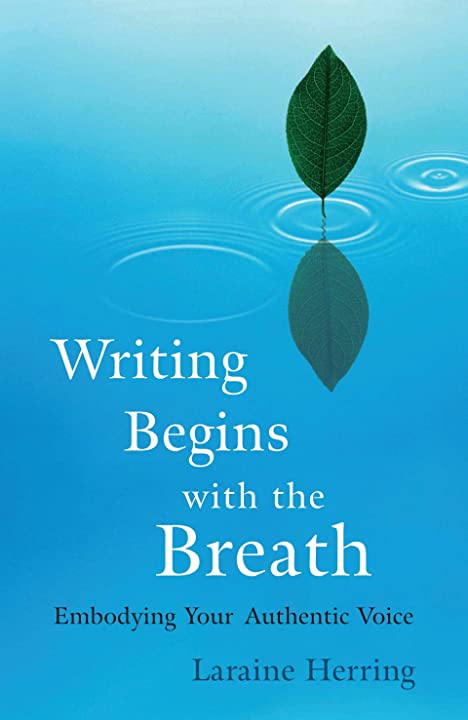
On the recommendation of Gayle Brandeis, I picked up a copy of Larraine Herring’s beautiful book Writing Begins with the Breath. I’m enthralled with the books quiet guidance and wisdom.

This morning I read her chapter on “Empathy” and found my thoughts spiralling into my essays in new ways – trying to be more connected to and less judgmental of the characters I write, especially since they’re real people. But more than that, I found myself thinking of the people in my life outside the page who I don’t always try to understand and know. The book, for a moment while it lasts, reminded me that compassion is the central goal of life.

And for those of you who love yoga as I do, you’ll find that Herring’s language comes largely from yoga practice, and you’ll even find that she works the body movement – today it was child’s pose – into the writing. It’s a lovely way to think about your body, your mind, your spirit and your writing.

Writing Begins with the Breath: Embodying Your Authentic Voice Cover of Herring's Writing Begins with the Breath

Recently Read